In February 2025, Andrej Karpathy — co-founder of OpenAI, former head of AI at Tesla — posted a 185-word tweet that quietly rewrote how a lot of people think about building software. He called it "vibe coding": a new way of working with LLMs where you "fully give in to the vibes" and "forget that the code even exists."
The tweet hit 4.5 million views. The New York Times, The Guardian, and Ars Technica covered it within weeks. By November, Collins Dictionary had named "vibe coding" its Word of the Year. By early 2026, Gartner estimated the vibe coding segment alone at $4.7 billion, growing 85% year-over-year.
Something real is happening. And if you've spent the last few years inside a no-code tool — Webflow, Bubble, Wix, Framer — it's worth understanding why a lot of the people who would have been your users last year are now building somewhere else.
This post is about the comparison specifically. If you want the plain definition and the current state of play, start with Vibe Coding in 2026: What It Actually Means.
What vibe coding actually is
The cleanest definition comes from Simon Willison, who's written more carefully about this than most: vibe coding is building software with an LLM without reviewing the code it writes.
You describe what you want in plain English. An AI writes the code. You run it. If it works, great. If it doesn't, you paste the error back in and let the AI fix it. You don't read the diffs. You don't particularly care what language or framework it used. The code is a byproduct. The product is the thing that runs.
Karpathy's original description captured the spirit exactly: "I see stuff, say stuff, run stuff, and copy paste stuff, and it mostly works."
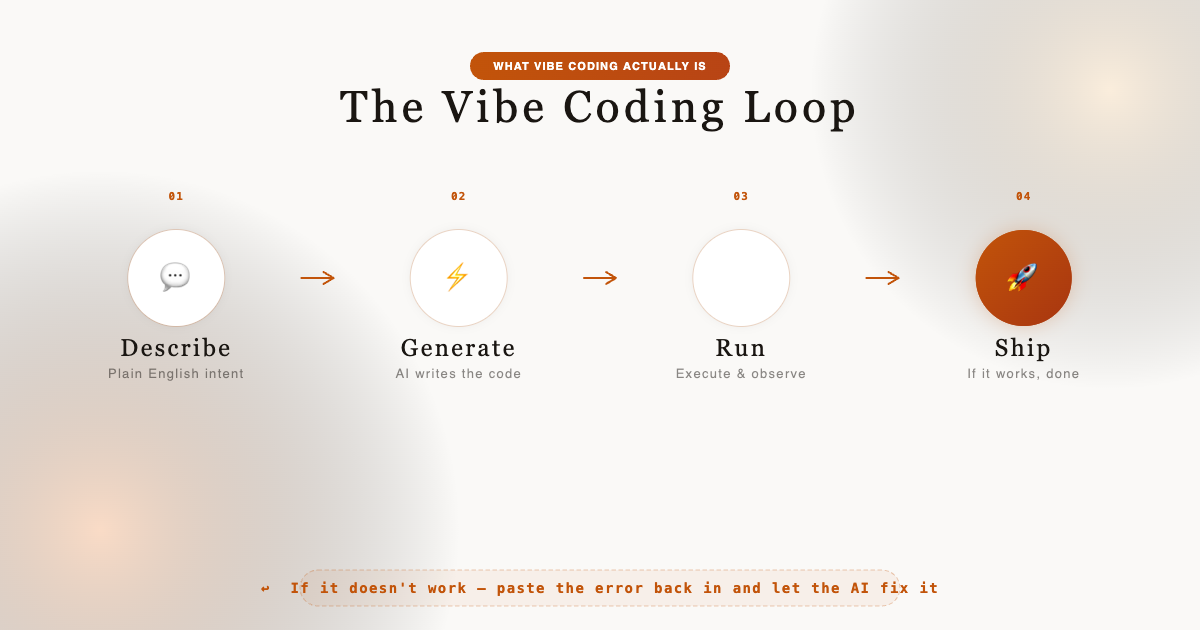
This is different from "AI-assisted programming" in general. A senior engineer using an AI assistant to autocomplete functions they'd have written themselves is not vibe coding — that's still software engineering, just faster. Vibe coding specifically means handing the implementation layer to the model and staying at the level of intent. If this sounds like a close cousin of designing a website with AI, that's because it is — the same philosophy, applied to a different layer of the stack.
The term matters because it names a category that already existed but didn't have a word. Y Combinator reported that 25% of startups in its Winter 2025 batch had codebases that were 95% AI-generated. Sundar Pichai said over 30% of new code at Google now comes from AI. A lot of software is already being built this way. Karpathy just gave it a name.
Why it's not the same thing as no-code
On the surface, vibe coding and no-code look like they're solving the same problem: let people build software without writing code by hand. Both promise accessibility. Both promise speed. Both target the same frustration — that the gap between having an idea and having a working product is absurdly large.
But the mechanics are different in ways that matter.
No-code gives you a visual editor over a constrained system. You drag components onto a canvas. You configure logic through menus. You work inside the platform's model of what an app or site can be. When your needs fit that model, it's fast — which is why structured starting points like a clear sitemap and well-considered wireframes have always been the backbone of no-code workflows. When your needs don't fit that model, you hit a wall — and the wall is usually invisible until you're already against it. The Webflow workflow is a clean example of where those walls show up.
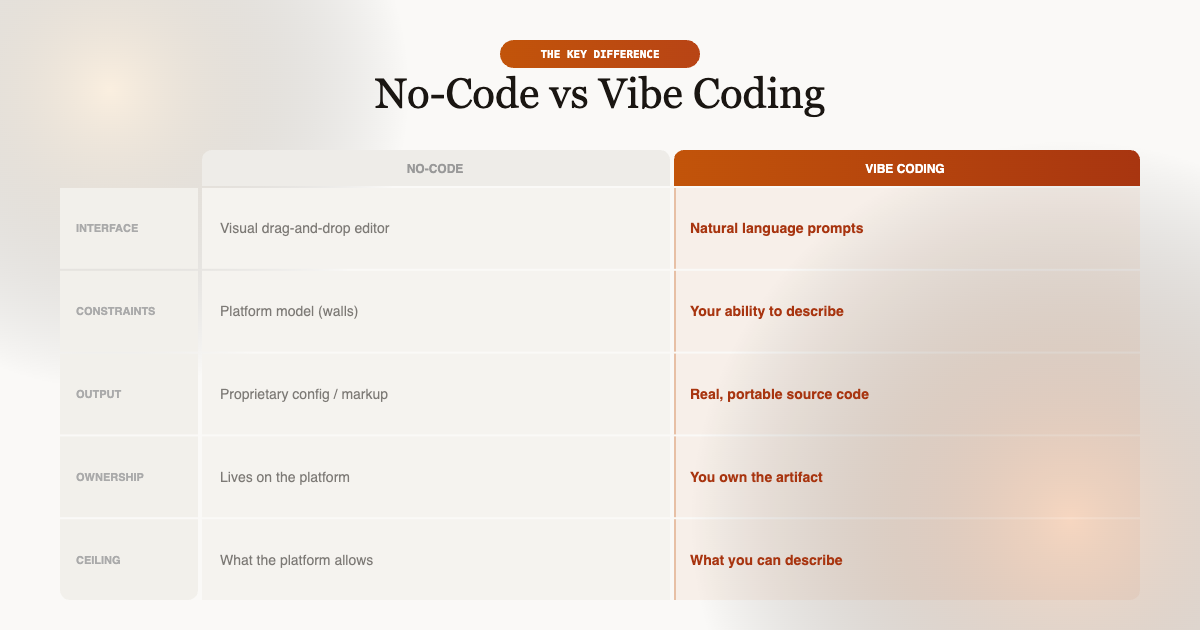
Vibe coding gives you natural language over an unconstrained system. You describe what you want, and the model writes actual code. There's no platform model to fit inside. If the thing you're describing is possible to build in code, it's possible to vibe code — custom animations, third-party API integrations, WebSocket connections, whatever. The constraint isn't what the platform allows. It's how well you can describe what you want and how well the model understands you.
That shift — from "what can the platform do" to "what can I describe" — is the real story. It's why vibe coding is eating into no-code's territory even though no-code isn't technically worse at most things. The ceiling is just higher.
There's a secondary point that matters too: ownership. No-code apps live on the platform that built them. If Bubble changes its pricing, you pay. If Webflow deprecates a feature, you adapt. If you want to move, you typically can't — you'd be rebuilding from scratch. Vibe-coded apps produce real source code. You host where you want. You own the artifact.
Why the shift is happening now
Three things had to become true at the same time for vibe coding to work, and they did, roughly in 2024-2025.
Models got good enough at code. By late 2024, Claude Sonnet and a handful of other models were reliably generating working code for a wide range of tasks. Not always clean, not always optimal, but functional often enough that the loop — describe, generate, test, adjust — got faster than writing it yourself for a lot of use cases.
Tools made the loop tight. Cursor, Bolt, Lovable, Replit Agent, Claude Code — each found ways to shrink the distance between "I want a thing" and "the thing exists." Karpathy's original tweet specifically mentioned Cursor Composer with voice input, because at that point he wasn't even typing. The interface became conversation.
The economics flipped. Generating a working prototype used to require a developer's time, which meant it cost real money and took real days. A prototype now costs a few cents of inference and takes minutes. When the cost of trying something drops by two orders of magnitude, people try more things. That changes what software gets built.
For website building specifically, the implications are sharp. The jobs no-code tools used to win — landing pages, portfolios, SaaS marketing sites, simple directories — are exactly the jobs vibe coding tools handle well. Short-to-medium complexity, clear visual intent, no hard infrastructure requirements. When someone can get a working site by describing it instead of learning a visual editor for three weeks, a lot of them choose describing it. That's the same intuition behind generating a full design system from a prompt rather than hand-configuring every token.
What vibe coding isn't good at (yet)
A good article on a hyped topic owes its readers the counter-evidence. Here's the honest version.
Maintenance is hard. Engineering teams are inheriting AI-generated codebases and finding them difficult to extend — a pattern widely reported in late 2025 as the "vibe coding hangover." GitClear's analysis of 211 million lines of code changes found that code duplication roughly quadrupled between 2021 and 2024, and the volume of refactoring dropped from 25% of changed lines to under 10%. The code works. It just gets harder to change over time.
Security is an open question. Veracode's 2025 GenAI Code Security Report found that 45% of AI-generated code contained security vulnerabilities. A December 2025 assessment of five vibe coding tools uncovered 69 vulnerabilities across just 15 test applications. If you're handling payments, personal data, or anything regulated, "it works" is not the same as "it's safe."
Complexity still bites. Once an app grows beyond a simple data model — multi-tenant, role-based permissions, complex business logic — vibe coding tools start struggling in ways that are hard to debug. A sentiment that's now common in developer communities: "Been vibe coding for 5 months, but went back to no-code." For certain kinds of business application, the structured constraints of no-code are a feature, not a bug.
Hallucinations are real. One study analyzed 576,000 AI-generated code samples and found over 200,000 references to software packages that simply don't exist. The code looked credible. It would just fail on install.
The reasonable read: vibe coding is not a universal replacement. It's extremely good at a specific shape of problem — prototypes, personal tools, marketing sites, MVPs, small-to-medium apps where speed matters more than long-term maintainability. It's worse than alternatives at enterprise systems, regulated workloads, and anything where the code has to be understood and extended by other engineers over years. For deeper background on where the term came from and how it's been received, the Wikipedia entry on vibe coding is surprisingly thorough.
What this means if you're building on a no-code platform today
The short version: no-code isn't dying. But the boundary between "use no-code" and "use vibe coding" is moving, and it's moving toward vibe coding for more and more use cases every quarter. The population of people who five years ago would have learned Bubble or Webflow is now a population considering Lovable, v0, Bolt, and Cursor.
The tools that survive this won't be the ones that cling to the old model — proprietary editors, platform lock-in, visual programming as the main interface. They'll be the ones that absorb what vibe coding does well (natural language as input, real code as output, ownership over artifacts) while keeping what no-code always did well (design quality, structured components, publishing infrastructure, the ability to ship something that looks professional without having to think about it). We've written before about why this matters more than yet another AI website builder slapped on top of old assumptions.
That middle path is roughly where the interesting work is happening in site-building right now. Not "replace no-code with raw code generation," not "keep visual editors forever," but something that takes the natural-language interface seriously while still giving you a platform that handles hosting, publishing, and the hundred small decisions you shouldn't have to make every time. That's the direction Modulify is heading — and the reason we think this shift matters more than the hype cycle around it suggests.
Modulify is an AI-powered site builder moving toward exactly that middle path — prompt-to-site with real design systems, standalone publishing, and built-in vibe coding for custom work. Try it free.